
How to Increase Payment Approval Rates for High-Risk Merchants
Low approval rates cost high-risk merchants thousands every month. Learn proven strategies to increase payment approvals and reduce checkout abandonment.
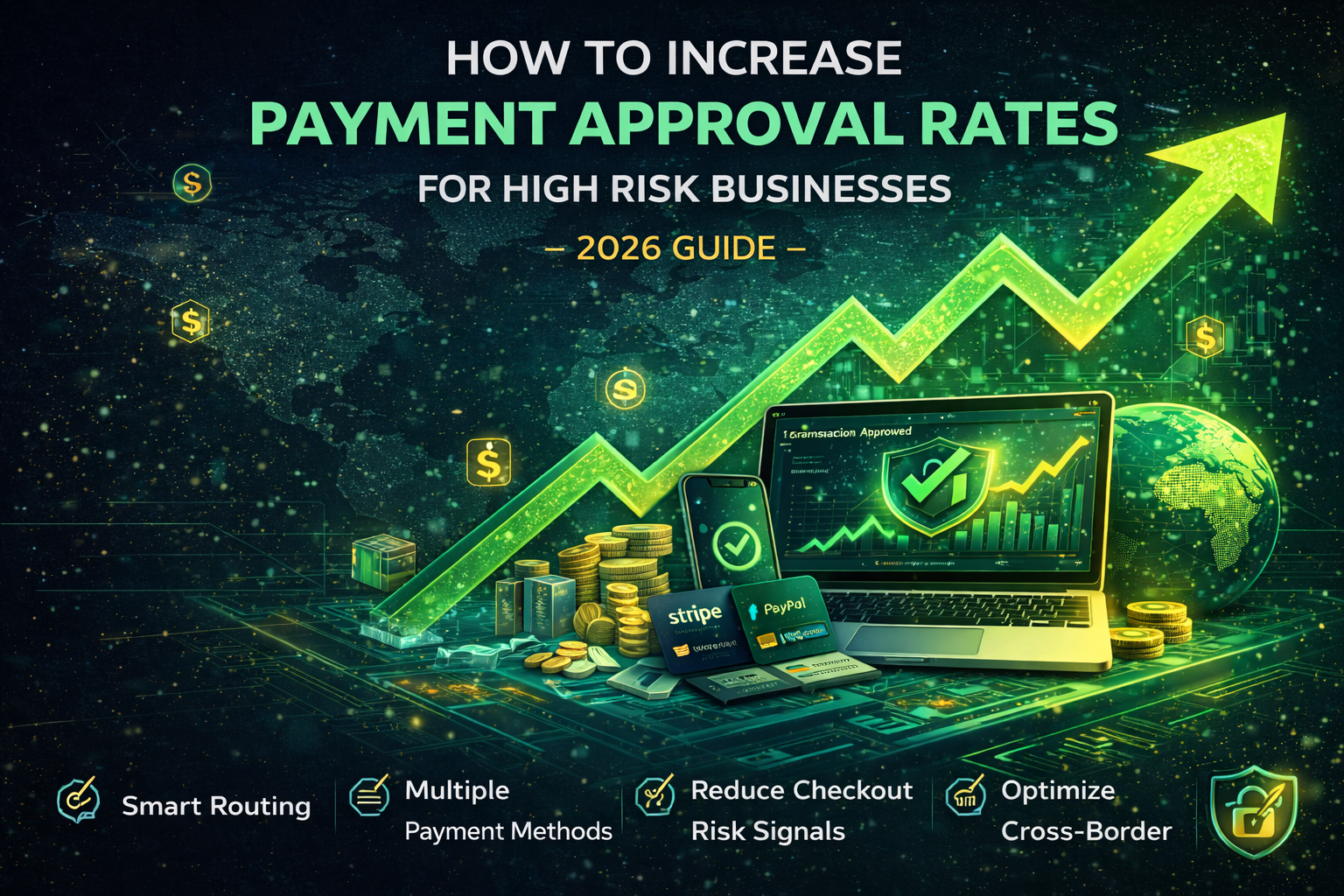
How to Increase Payment Approval Rates for High Risk Businesses (2026 Guide)
If you run a high-risk online business, your approval rate determines your real revenue.
Not your traffic. Not your conversion rate. Not your ad budget.
Your payment approval rate.
If 20% of your transactions fail, that means you’re losing 20% of potential income instantly — even after customers decided to buy.
This guide explains exactly how high-risk businesses can increase approval rates, reduce declined transactions, and build stable payment infrastructure in 2026.
Why Payment Approval Rates Matter More Than Traffic
Let’s use a simple example:
- 10,000 visitors
- 3% conversion rate = 300 orders
- 20% decline rate = 60 lost orders
That’s 60 customers ready to pay — but blocked by your infrastructure.
At scale, this becomes catastrophic.
Why High-Risk Businesses Experience More Declines
High-risk industries face additional scrutiny from banks and card networks.
Common reasons for declines include:
- Automated fraud scoring
- Cross-border payment restrictions
- Subscription billing flags
- Industry risk profiling
- Single acquiring bank dependency
This is why traditional providers often freeze or restrict accounts. We explain this deeper here:
Why Stripe Freezes High Risk Accounts
Strategy 1: Implement Smart Routing
Smart routing is one of the most powerful tools available to high-risk merchants.
Instead of sending every transaction through a single provider, smart routing dynamically selects the optimal path based on:
- Customer location
- Card issuing country
- Currency
- Historical approval performance
This increases approval probability dramatically.
This infrastructure approach is explained in detail here:
High Risk Payment Gateway No KYC – The Ultimate Solution
Strategy 2: Offer Multiple Payment Methods
Customers trust familiarity.
If a card fails, and you offer no alternative, the sale is gone.
By offering:
- Credit & Debit Cards
- Google Pay
- Apple Pay
- PayPal
- iDeal
- Revolut
You reduce friction and increase fallback options.
More options = higher effective approval rate.
Strategy 3: Reduce Fraud Signals at Checkout
Many declines are triggered by fraud scoring systems.
You can reduce risk signals by:
- Clear product descriptions
- Transparent refund policies
- Visible contact information
- Matching billing descriptors
- Consistent pricing display
Banks are more likely to approve transactions from trustworthy environments.
Strategy 4: Optimize Cross-Border Transactions
International payments often fail due to:
- Currency mismatch
- Local bank restrictions
- Regional fraud filters
Using infrastructure designed for global merchants dramatically reduces this problem.
Understanding merchant account structure also helps:
High Risk Merchant Account vs Payment Gateway
Strategy 5: Monitor Chargeback Ratios
High chargeback ratios lead to tighter fraud controls.
Lowering chargebacks increases approval rates indirectly.
Best practices:
- Clear communication
- Proactive refunds
- Strong customer support
- Transparent subscription terms
Strategy 6: Use High-Risk Specialized Infrastructure
Traditional processors optimize for low-risk industries.
High-risk merchants need infrastructure designed specifically for their business model.
This includes:
- Smart routing
- High-risk aware underwriting
- Multi-provider redundancy
- Fast settlement structures
For a full infrastructure overview, read:
Why EcomTrade24 Pay Is the Best Payment Gateway for High-Risk Businesses
The Compounding Effect of Higher Approval Rates
Improving approval rate from 80% to 90% increases revenue by 12.5% without increasing traffic.
That’s pure infrastructure optimization.
No additional ad spend required.
Final Thoughts
Declined payments are silent revenue killers.
High-risk businesses cannot afford unstable processing.
Increasing approval rates requires strategy, transparency, and optimized infrastructure.
In 2026, serious merchants understand:
Payment processing is not just technical — it is strategic.
Why payment approval rates drop even when a merchant is legitimate
Many declines are caused by a mismatch between checkout presentation, buyer geography, card behavior, device signals, and the payment path itself. Merchants often blame traffic quality when the real issue is that the payment setup is too generic for the sales pattern.
Practical levers merchants can control
- Present the product, price, and billing terms clearly before payment
- Match payment methods to buyer country and currency expectations
- Reduce unnecessary friction and confusing wording on checkout pages
- Use a payment setup that fits the actual risk profile of the business
Approval rates improve when the payment flow looks consistent, understandable, and properly matched to the business model. That is as much a checkout problem as it is a processor problem.