
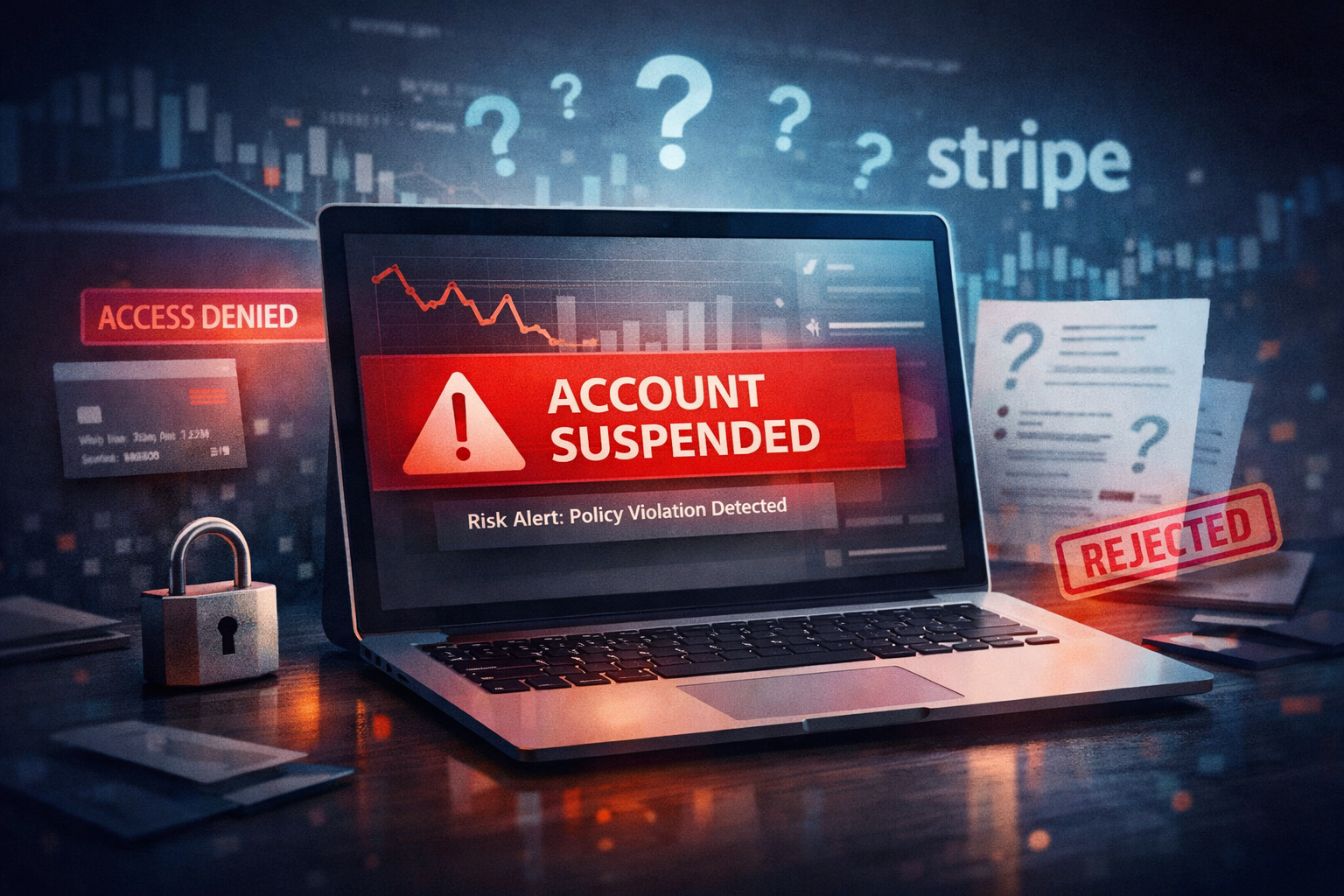
Why Stripe Bans Merchant Accounts (And How to Prevent It)
Stripe account bans rarely come with clear explanations. This article breaks down why legitimate businesses get shut down, what actually triggers payment risk systems, and why bans often happen after growth — not before.
One of the most frustrating moments for an online business is waking up to a payment provider shutdown — especially when no clear explanation is given.
Stripe is widely used by startups, creators, SaaS companies, and eCommerce stores. Yet every week, legitimate businesses lose access to payments with messages like “account terminated due to policy violations” or “high risk activity detected”, without any concrete details.
Stripe bans are rarely personal
Contrary to popular belief, most Stripe bans are not the result of manual reviews or personal judgments. They are the outcome of automated risk models designed to protect the payment network as a whole.
These systems evaluate patterns — not intentions. A business can be fully legitimate and still trigger red flags simply by behaving outside of what Stripe considers a “safe” profile.
Why bans often happen after growth
A common misconception is that payment problems appear early. In reality, many accounts operate without issues for months or even years before a shutdown occurs.
Problems tend to surface after growth milestones:
- Sudden increases in transaction volume
- International traffic or foreign cards
- Subscriptions or recurring billing models
- Digital goods or instant delivery
- Higher refund or dispute ratios
From a risk system’s perspective, these signals increase uncertainty — even if the business itself hasn’t changed anything intentionally.
Why explanations are often vague
Payment providers intentionally avoid sharing detailed reasons for bans. Revealing exact triggers would allow bad actors to reverse-engineer risk systems.
As a result, legitimate merchants are often left with generic responses, limited appeal options, and long waiting periods — all while cashflow is frozen.
The real risk: relying on a single provider
The biggest mistake many online businesses make is relying on a single payment provider. When that provider shuts down access, operations stop immediately.
This isn’t a Stripe-specific issue. It’s a structural risk inherent to modern online payments.
Businesses that survive payment disruptions usually have contingency plans, alternative routing options, or backup payment flows in place — long before a shutdown happens.
Dealing with this situation right now?
This page explains how businesses typically handle payment provider shutdowns and what options are usually considered after an account ban.
View options →Need a more stable payment setup for high-risk or fast-growing stores?
Learn more about our no-KYC fiat payment solution →Frequently Asked Questions
Why do payment gateways freeze merchant funds?
Most payment gateways freeze funds due to automated risk scoring, chargebacks, or sudden volume changes. High-risk merchants are affected most often.
Is a payment gateway without KYC legal?
Yes. Depending on jurisdiction and transaction type, alternative compliance models can be used instead of traditional KYC.
What is the safest alternative to Stripe or PayPal?
Specialized high-risk and white-label payment gateways offer more stable payouts and fewer sudden account shutdowns.
Need a payment setup that won’t get frozen?
Get an instant-approved payment gateway built for high-risk and digital businesses.
Start now – instant approval