
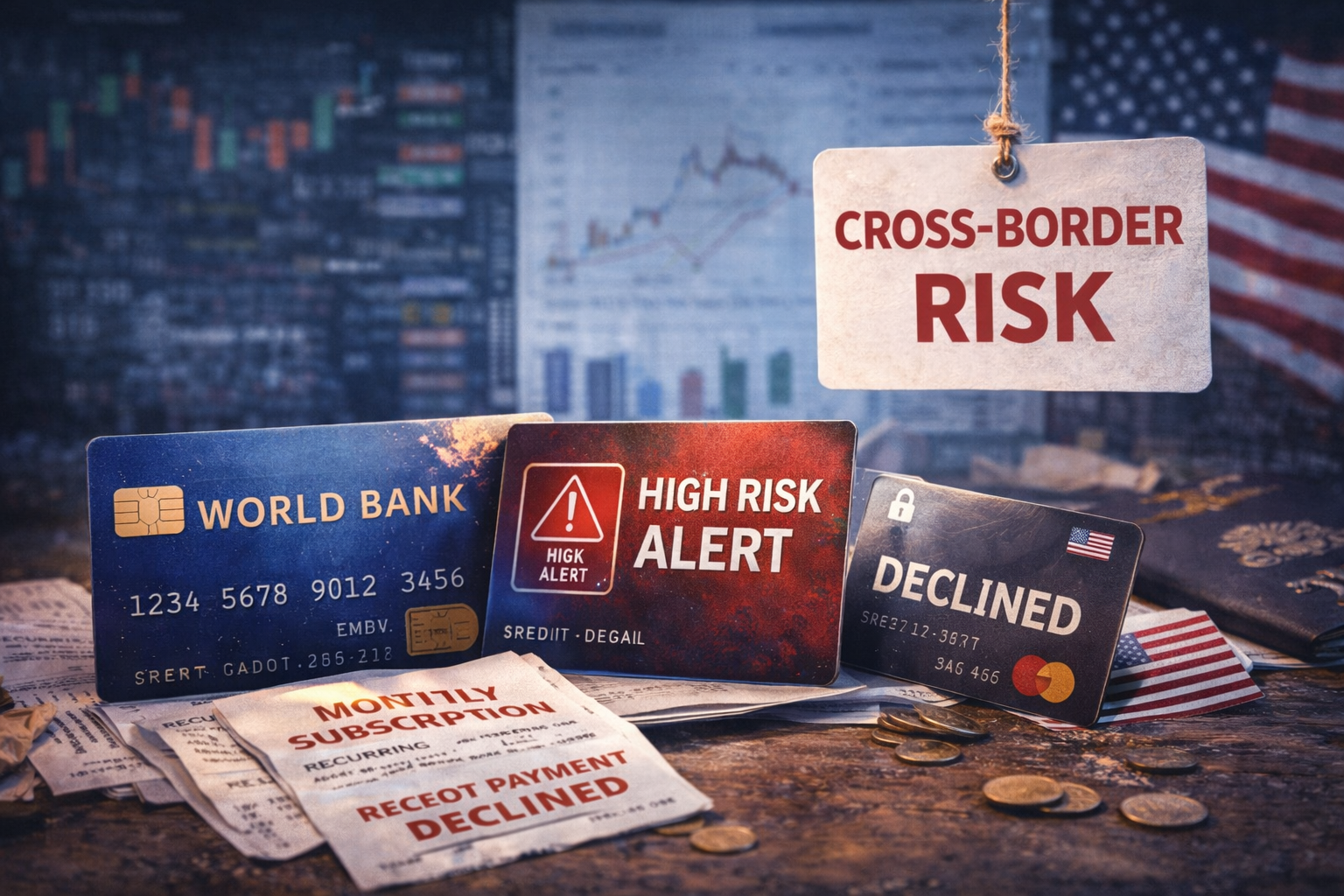
International Cards Increase Payment Risk
Accepting international cards can quietly change how payment providers assess risk. Many businesses only discover this after payouts slow, reviews start, or restrictions appear.
Expanding internationally is often seen as a milestone. More traffic, more customers, more revenue. From a business perspective, accepting international cards feels like progress.
From a payment risk perspective, however, cross-border transactions change almost everything.
Why international cards are treated differently
Payment providers do not evaluate all card transactions equally. Domestic cards operate within a familiar legal, regulatory, and consumer protection framework.
International cards introduce variability: different banks, dispute rules, timelines, and enforcement standards. This increases uncertainty for the payment network.
Even legitimate businesses feel this shift immediately once foreign card volume increases.
Cross-border disputes are harder to resolve
When a dispute involves an international card, resolution becomes more complex. Communication across banks and jurisdictions takes longer, and outcomes are less predictable.
For payment providers, slower resolution means longer exposure to potential losses. Risk systems account for this automatically.
Small percentages still matter
Many merchants assume that international cards are harmless if they represent only a small share of transactions.
In reality, risk models are not linear. A relatively small percentage of cross-border payments can significantly change a merchant’s overall risk score.
This is especially true during growth phases, when volume increases faster than historical data can stabilize.
International traffic often correlates with other risk signals
Cross-border payments rarely appear in isolation. They often coincide with:
- New advertising campaigns
- Rapid traffic growth
- Currency conversions
- Shipping delays or digital delivery verification issues
Individually, these factors may be manageable. Combined, they amplify perceived risk.
Why restrictions often appear without notice
Merchants often expect warnings when risk increases. With international cards, reviews are frequently automated.
Thresholds are crossed silently. By the time a notification appears, the account may already be under restriction.
The common misconception: “More customers equals less risk”
Growth feels like validation. More customers should mean stability.
In payment systems, the opposite is often true. Growth without geographic and operational alignment introduces uncertainty rather than reducing it.
How resilient businesses handle international payments
Businesses that operate internationally for the long term usually adapt their payment infrastructure early.
This often includes:
- Separating domestic and international payment flows
- Adjusting acceptance rules by region
- Preparing for longer review cycles
- Reducing single-provider dependency
These measures reduce friction and limit exposure when reviews occur.
International payments require structural planning
Accepting international cards is not inherently risky. The risk arises when expansion happens faster than payment systems can adapt.
Businesses that understand this dynamic are far less surprised when reviews occur — and far better prepared when they do.
Experiencing reviews after going international?
This page explains how businesses usually adapt payment infrastructure once cross-border traffic increases.
View options →Need a more stable payment setup for high-risk or fast-growing stores?
Learn more about our no-KYC fiat payment solution →Frequently Asked Questions
Why do payment gateways freeze merchant funds?
Most payment gateways freeze funds due to automated risk scoring, chargebacks, or sudden volume changes. High-risk merchants are affected most often.
Is a payment gateway without KYC legal?
Yes. Depending on jurisdiction and transaction type, alternative compliance models can be used instead of traditional KYC.
What is the safest alternative to Stripe or PayPal?
Specialized high-risk and white-label payment gateways offer more stable payouts and fewer sudden account shutdowns.
Need a payment setup that won’t get frozen?
Get an instant-approved payment gateway built for high-risk and digital businesses.
Start now – instant approval