
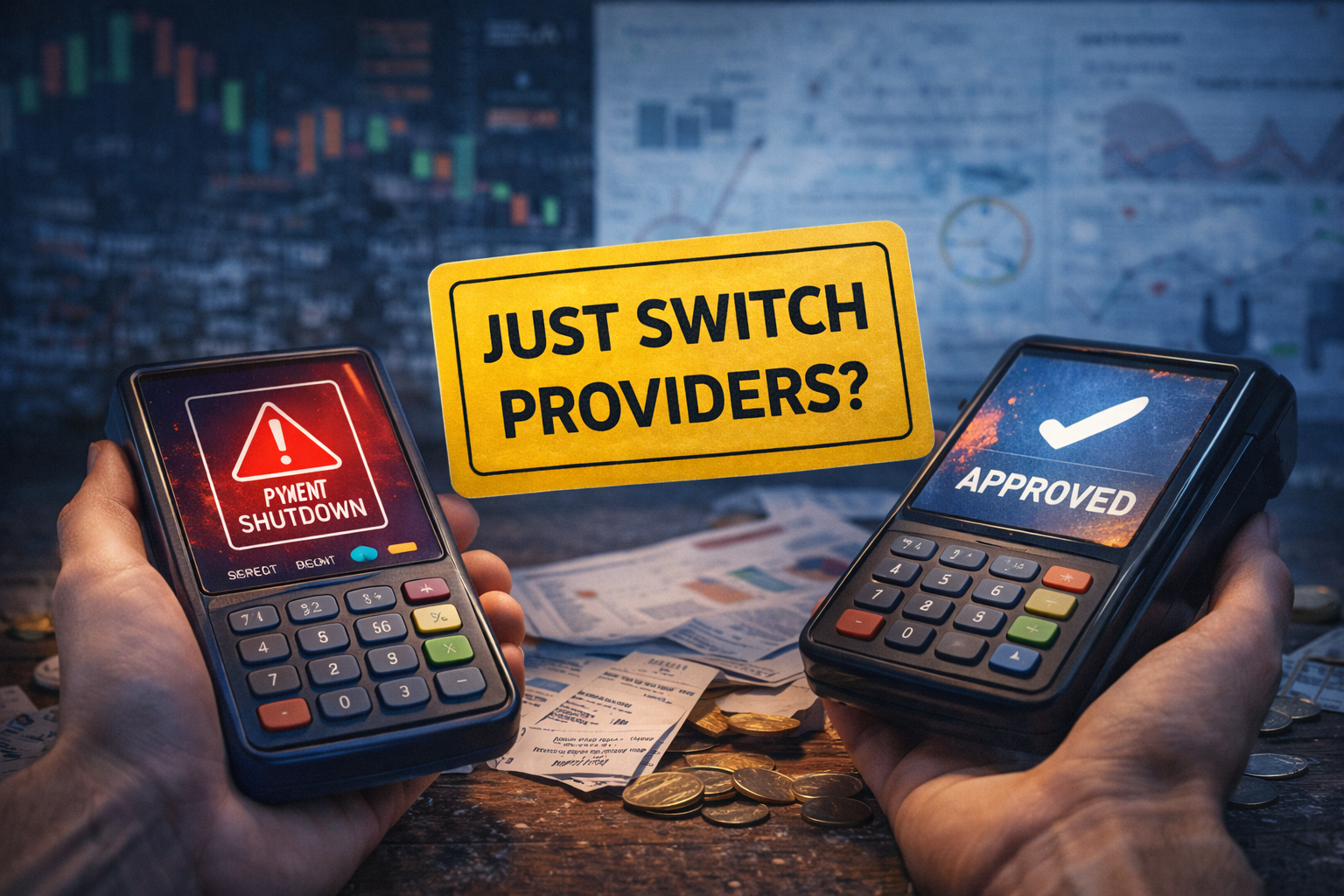
“Just Switch Payment Providers” Is Dangerous Advice Guide
After a payment shutdown, many businesses are told to “just switch providers.” This article explains why that advice is often dangerous, why bans follow patterns, and why payment issues are rarely solved by switching alone.
When a payment provider shuts down an account, advice pours in quickly. Friends, forums, and social media often repeat the same suggestion: “Just switch payment providers.”
While this advice sounds practical, it is often misleading — and in some cases, actively harmful.
Switching providers doesn’t reset risk
Payment risk is not tied to a specific provider. It is tied to transaction behavior, customer patterns, and how a business operates.
When these patterns remain unchanged, switching providers simply transfers the same risk profile to a new system.
In many cases, this leads to repeated reviews, shorter tolerance windows, or faster shutdowns.
Why repeated applications raise red flags
After a shutdown, some merchants apply to multiple providers in quick succession.
From a risk perspective, this behavior itself can appear suspicious. Rapid onboarding attempts combined with unresolved risk signals reduce trust rather than restore it.
Payment issues are usually structural
Most payment disruptions are not caused by a single violation. They result from structural factors such as:
- Business models with delayed fulfillment
- High dispute sensitivity
- Rapid scaling without payment adaptation
- Single-provider dependency
- Geographic or currency mismatches
Without addressing these factors, switching providers rarely produces a different outcome.
Why this advice keeps circulating
“Just switch providers” persists because it offers hope. It suggests a quick fix to a complex problem.
Unfortunately, payment infrastructure does not work like software tools. It requires alignment between business behavior and risk tolerance.
What actually works instead
Businesses that recover successfully usually take a step back before taking action.
They analyze why restrictions occurred, how risk is perceived, and which parts of the payment flow need adjustment — before introducing new providers.
This approach is slower, but far more effective.
Dealing with repeated payment shutdowns?
This page explains how businesses typically reassess their payment setup after restrictions — before switching providers.
View options →Need a payment gateway that’s built for global reach and higher-risk businesses?
View EcomTrade24 Pay payment gateway options →Frequently Asked Questions
Why do payment gateways freeze merchant funds?
Most payment gateways freeze funds due to automated risk scoring, chargebacks, or sudden volume changes. High-risk merchants are affected most often.
Is a payment gateway without KYC legal?
Yes. Depending on jurisdiction and transaction type, alternative compliance models can be used instead of traditional KYC.
What is the safest alternative to Stripe or PayPal?
Specialized high-risk and white-label payment gateways offer more stable payouts and fewer sudden account shutdowns.
Need a payment setup that won’t get frozen?
Get an instant-approved payment gateway built for high-risk and digital businesses.
Start now – instant approval